Showing posts with label snails. Show all posts

July 16, 2009

My garlic is so Money!


Remember these?
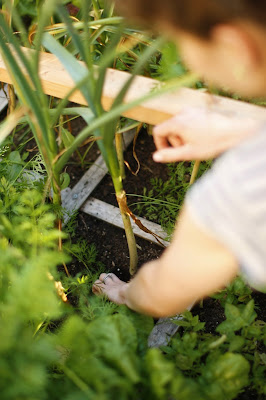
The other day, curiosity overcame my patience. I had to meet my underground friends that have lived in the front garden since, well, November!

So I dug and dug,

And pulled a little and . . .

It smelled so wonderful!

Hooray!

I dug up the rest (all 11) and now they're drying/curing in the kitchen. 

As a triumphant aside, I went to the Davis Square Farmers Market yesterday and had an experience that thrilled me to my toes. Usually, I walk the aisles of the market and feel a wee bit inadequate because my city-girl produce doesn't often match the pros' goods. Well, that has all changed with this garlic harvest! We blew them away. It would have taken 3 of their bulbs to match even one of ours! Finally, something came out of our ground that I can be really proud of. 

I mention this because on the same day I dug the garlic, I also pulled the a carrot and the beets.


Yah, don't get too excited. They're pretty tiny.

So I sliced them up, sauteed them in some EVOO tossed in the beet greens and served it over proscuitto brown rice and wild salmon garnished with fresh green snap peas.


And look who else came for dinner?

October 3, 2008

Preparing for winter; Part 1 + other miscellany

Usually, fall is my favorite season. But this is not the usual year, for me. This year, I have a garden, and now fall means many new things, some of them ominous.

The gorgeous, almost violent bloom and harvest of this past growing season can't go on forever, and though I plan to try my hand at cold-frame crops over the winter, the time has come to prepare for the season ahead.

So I made a list . . .. . .and then ignored the list because 'turning compost' was #1 and I didn't want to do it.

So onto the tomatoes, which had to go.First, I had to disentangle them from the nine-zillion green twisty ties that secured them to innumerable bamboo posts:I salvaged what ripe tomatoes I could before sending the rest to the wheelbarrow, but most of them were destined for the compost bin.Here's the bed after I removed the tomato plants:
Ideally, I would immediately enrich the beds with finished compost, but when I went to check and turn the compost, I found it to be mid-cook and nowhere near finished. That is to say, it was very stinky and steamy. I don't think it comes through very well in this picture, but you can see some steam rising where I lifted a layer with the pitchfork:(it's not easy to stir and photograph compost simultaneously.

The other composter was further along. I knew this for several reasons. First, the volume had halved (several weeks ago, it was completely full). Second, it didn't reek. And third, it was much cooler. But it has a way to go because some of its components are still recognizable.I'm about to sound like an expert here, but in fact, I have no idea what I'm doing - this is all the result of a little research.)

After a season's worth a growth, it's a good idea to do something restorative for the soil (in addition to enriching with finished compost at some point). Farmers will often plant a crop that fixes the nitrogen in the soil into a more crop-friendly form and then acts as a "green manure" when it's tilled under and decomposes. Many plants in the legume family are good for this (such as buckwheat).

I had a couple to choose from (thank you, Mom), but I decided on the one that sounds like medicine you'd give a cat with indigestion: "hairy vetch."

The seeds of hairy vetch are small and round, like shrunken, smooth peppercorns. I dug up the squares where the tomatoes had been and planted several sprinklings of the seeds. I have no idea what to expect, but we'll see what happens.

While I was poking around in there, I came across a beautiful snail doing some serious damage to the pepper plants:He was relocated to the hydrangea bush.

The final thing on my list was the chives - they were out of control. So I chopped them all down and decided to give a go at drying them in the oven (despite the firm warnings on numerous websites about how they will lose their flavor).

Chopped them up, spread them on some cookie sheets and stuck them in the oven on the lowest setting:I had too many chives to dry in the oven, and I've always wanted to try chive scones, so I decided to try out a (half-made up) recipe:

Don't preheat the oven (I'll explain why later).

sift together:
  • 1 1/2 cups white flour
  • 2 tsps baking powder
  • 1/2 tsp salt

blend with (I used a food processor)
  • 3 tbps butter
  • 1/2 cup (or more) fresh chives

  1. Put flour mixture in bowl and make a well in the middle.
  2. Pour in a little more than 1/2 cup milk, but you want to use as little as you can get away with so the scones will be more flaky than chewy.
  3. Cut in the milk with a knife, and combine just to the point where it all hangs together. Over-working the pastry dough will make it tough.
  4. Turn it onto a floured surface, and roll it out to about 1" thick. Cut the scones out (I used a cookie cutter because I didn't have anything else) and place on an ungreased cookie sheet.
  5. I used an egg wash made of an egg white and a touch of milk, whisked together with a fork. Brush it over the scones.
  6. Sprinkle lightly with fresh-ground pepper and a touch of coarse salt.

Now for the confusing oven part:

I recipe I was using for reference suggested putting the oven at 220 degrees, but after a minute or two, I decided that would be entirely too low a temperature, and cranked it to 405 and eventually to 430 degrees. So next time, I think I would just put them in a cold oven and set it to 405 degrees, so it could rise and bake a bit before reaching full temperature. After it reaches 405, turn it up to 430 so the tops brown a little. Once the tops are golden, they should be done, and it shouldn't take more than 20 minutes, tops.

Here they are (er, were, before Erik ate them all):He calls them "grass cookies." So I guess that's what they are!

September 1, 2008

Million shades of green

I’m on the plane to Minneapolis via Atlanta, which confuses my understanding of American geography, but at least it gives me more time to write.

After a whirlwind return to Massachusetts, I’m returning to a week or more on the road venturing to the infinite places that aren’t my home. It’s an exciting time right now. Politics looms large in the collective consciousness, as does hurricane Gutav, which is barreling toward the Gulf coast as I now write. The Republicans have just pretty well called off the RNC, and my editors are making scrambled eggs out of their brains trying to figure out how to send the right photographers to the right places. So down in the cargo hutch of this airplane is a red suitcase packed with nice black slacks, pressed shirts and mascara. Next to it is a sister suitcase containing, among other things, walkie-talkies, industrial-strength D rings, a water filter and Cipro.

I know where this plane will land, but I don’t know where I’m going, when or how.

As I said, it’s an exciting time right now, especially for a journalist.

The mood is very different in my garden. I returned home last Friday evening to discover, not the riot of ripeness or pestilence I feared, but the result of a steady week of peaceful churn. There were babies everywhere, all asleep. Erik spotted our first cantaloupe, the first of an otherwise unproductive crop of plants.

The pepper plants decided to try it all over again after a rough patch with the snails.
And my stubborn, brave squash just won’t give up, and have pushed out ever more tiny squashlets, powdery mildew be damned. I just shake my head and wish them luck.
From now on, I plan to plant radishes every chance I get. Multiple plantings each season. Wherever I can. I’m not even sure if I like radishes, but the sheer joy the seedlings exhibit upon germination is worth the effort and space. I bent down to check on their progress and to evaluate how many went the way of the skunk salad bar and was met with a tiny, green, full-throated “Yippeeeee!!!”

They are so lovely, and so excited to be alive. I love radishes. I don’t care if they’re awful. I just love them for this un-ironical reminder of the joy of living.

Oh, God. Bad pun alert: Lettuce all be like radishes.

Sorry…sorry.

One of our squashes fell victim to some furry animal with sharp teeth. It’s now in the shed, where I hope it will cure without rotting.
We harvested a bunch more pole beans and I made the tuna salad with them again. I think that’s going to be a staple around our house. It’s easy, healthy, cheap and delicious.
And in the 48 hours I was home, I made four loaves of bread. That sounds ambitious, but it is so incredibly easy and so sinfully scrumptious when hot out of the oven that to only make four loaves was restraint.

We ate two of those loaves with caprese salads, made divine by just-picked Brandywine tomatoes and expensive-but-worth-it buffalo mozzarella. I am in love with summertime garden eats.

The compost needed a turn, and in the process of turning it, we managed to explode the composter in half. That was fun.

Lesson learned: if using an “Earth Machine” brand composter, glue the damn thing together before filling it up with stinky stuff.

Mostly, I just puttered about outside, barefoot, dirty, and probably not wearing enough sunscreen. I admired the ginormous spider, sniffed the jasmine that’s just starting to flower along our fence, and tried to absorb as best I could the very different priorities of dirt, sun and plants.

Our left brains are tyrants. They narrate constantly, and not just the negative events of our lives. They ruin the restful and beautiful moments as well, like red-faced sports announcers, and they just never shut up. Well, almost never.

My left brain retires after a glass of red wine.

Sometimes, it shuts up for a blessed minute toward the end of a great yoga class.

But I think the reason I’ve fallen so completely in love with gardening, has to do with that insistent narrative. It’s not that gardening turns off the voice, but it tames it, and the telegrams streaming through my consciousness begin to describe what is actually happening in front of me.

That – flower – is – gorgeous. The – tomatoes – smell – great. I – feel- sorry – for – the – squash. How – amazing – is – germination. I – am – incredibly – lucky.

It’s a different time zone. A different sort of planning. No deadlines, more just a continuum. And no black and white.

Rather, I just see a million shades of lovely green.

August 17, 2008

Jonah and the worm

The last post was a bit of a downer; sorry about that. This one should be better.

I'll start out with a happy picture.


They look like good friends, don't they?

About the whole dying of squash and feelings of failure and frustration thing - I've come to some thoughts about it.

(these are the dying cucumbers:)
It's out of my control, and I shouldn't get angry about it.

In fact, I didn't even plant those squash. They literally kept popping out of the ground (from the compost, I think) and I pulled all except for two in the name of science. Until they declared themselves as butternut squash, I called them "mystery plants." That's what they were - a mysterious gift that came out of the dirt.

And then they died, but they weren't mine to begin with, so I should get over myself. That sums up a lesson that pops up in many religious traditions (for instance, the Hindu god Shiva both destroys and creates), but I came across an old testament story that deals with an actual squash.

(Spoiler alert: I'm an agnostic and not pushing any particular religion or religion in general here)

At the end of the story of Jonah, he's sitting on a blazing hot hill waiting to see if God will smite a sinful city that Jonah had warned to repent. While he's waiting, God causes a squash plant to grow over him to provide shade and comfort. Then the next day, a worm kills the squash. Jonahs' pissed and yells at God, who basically replies, 'Hey, it wasn't yours anyway, so chill.'

My takeaway is that it's just not about me. I can appreciate the heck out of gardening and helping things grow, but I'm a part of the process just like the rain or the plants. My ego has gotten in my way, and it's blocking the view.

And look: the squash is sending up flowers even as it goes down in flames. Now that's life force!
End sermon.

Back to garden.

Another happy picture:Marigolds are just about the coolest plants ever. You can't kill them, they bloom all summer and they repel all sorts of bugs.

The brussel sprouts are looking like the nipples of a very pregnant dog:
The bell peppers (the ones that did not fall victim to the recent snail onslaught) are starting to blush. It's adorable:
Here's the snail that killed my other beautiful pepper. But I'm not mad (see above).

The cilantro has gone to seed, but I'm letting it go because it is so darn pretty:
We have 20,000 green tomatoes just waiting for me to go out of town to turn red.
And the behemoth Brandywine is just about to become lunch.

I've given up on the onions I had planted several months back. The tops had fallen over long ago, but I just packed them with compost and figured I'd give it time. Well, today, the tops were officially dead and gone, so I dug up what there was and plan to use them in a bean salad soon. They appear to have multiplied underground, but I must have planted them too close together and they just stopped growing.

Lesson learned: plant onions farther apart.
And on the jam front: last night I made 35 (that's thirty five) jars of peach jam. They were selling lavender flowers at the farmers market, so I got frisky and made a small batch with those, and a small batch with both candied and fresh ginger. I also swapped out the cane sugar, to a large extent, with clover honey. Tastes good; bad idea.

The stuff will not gel. Arg!! I have 35 jars of yummy slop. Gr! But at least it looks pretty.So lesson learned: don't use honey in jam. Or at least, don't expect it to gel if you do.

That's all for now, friends.