March 5, 2010

Mail-Order Chicks!


You all know what that means, boys and girls. The girls have arrived!!!!!

Now, for a peep show:


I've been talking about getting these girls for a long, long time now, and our chicken dreams are finally becoming a reality. Yesterday, Erik and I picked up our 6 adorable Buff Orpington chicks from the Waltham Agway. We're having a difficult time doing anything but stare at them, but I've peeled myself from their brooder long enough to type these few words and post this video.

A little info about the breed. Buff Orpingtons are known to be the Labrador Retrievers of chickens. They're big, golden brown, affable and tame. They're considered to be a dual-purpose breed; that is, they are useful as laying chickens and as, ahem, dinner. We'll see what the future holds, but Erik and I have a feeling that this may lead us even further down the 'vegetarian' pathway.

For now, we're transfixed.

February 28, 2010

Plans becoming plants (and chickens)


Yay!

Today was a 'makin' things happen' day. Erik and I went to our local Agway (more on that in a minute) to get supplies for our chicks, who are coming on Thursday, March 4 or so, and also some extra plant-starting stuff. I'll tell you, one of the challenging things about doing this urban agriculture stuff is that it's so in vogue and in style these days that most of the places that cater to urban gardeners are over-priced, shi-shi boutiqu-ie type places. No joke - I can buy a decent latte at my local garden outlet, but the prices I pay make me feel like a fool. So now that I'm in the market for chicken feed (and organic chicken feed, at that), I have to do some serious pecking here in metro Boston to find a decent and reasonably priced supplier.

Found one!

Agway in Waltham. Annoyingly, though, they have zero online presence. You can't search their stock online or even view a website. All you can find is this google link with an address and phone number. But take it from me - it's a great value, the staff is super friendly and helpful, and you can find anything you need for pretty heavy-duty gardening and basic livestock needs.

So when we get the chickies, they'll need oodles of TLC. They can't regulate their own body temperature for a while, so they have to be raised in a brooder - a small, protected area that can be heated to body temperature (about 100 degrees), protected from drafts and from (most importantly in our household) our cat. A proper reinforced brooder can cost in the hundreds, so Erik took matters into his own hands:


He's constructed a basic brooder that will house our 5 buff orpington pullets (young female chickens) from age 1-day through 5 or so weeks.

Here are his architectural sketches:

He designed it to be tall enough and wide enough to hold five 5-week old pullets (which is about how old they'll be before graduating to their next home). The height is about 20", which is the height the heat lamp needs to be to produce a 100-degree reading at floor level.

This simple brooder is constructed from chicken wire and plain wooden stakes.


Then they'll move up and out into the larger world, and into their henhouse, which I've decided needs to be called the Nunnery.


Meanwhile, I sorted seeds and started the varieties that will need to get an indoor head start.
Started in pots are: tons of basil, marigolds, fennel, kale, tomatoes, ground cherries, all sorts of flowers, chives, cilantro, eggplant, and I forget what else.

Oh, I planted directly into pots that will decompose when planted in the ground. For the last two years, I've struggled with transplant shock - the crashing that happens to my fragile seedling starts when I rip them from their nursery container and plant them naked in the ground. This year, I decided to try this method, which seems to me to be kinder and gentler on developing root systems. Of course, it's alway important to harden off the seedlings (expose them gradually to the elements) before setting them out permanently.

Tomorrow or the next day, I'll direct seed the beets, carrots and spinach in the cold frames.

February 25, 2010

To hell, then heaven and back; now holding a Map. (for the garden)

This has been an interesting, no - *interesting* season for me. I do desire a life experience that touches the full range of human emotions, and well, the Universe listens to earnest requests.

Right after my last post, a horrible earthquake leveled much of Haiti. I traveled there immediately to cover it for the Globe (I was embedded with a disaster response medical team). It was a deep long look straight into Hell. Here are some of my videos I did there. The first one is a recap of my experience there.


And then I came home to my blessed world. Back to my husband, our cat (who eats special canned food!), healthy friends, a house! The stark contrast had me in shock. But I soaked it all back in like a wrung-out sponge and happiness rescued me from the darkness I'd seen. The next video I created was a lark - a personal, silly video valentine for Erik that I'm happy to embarrass myself with here:


Really, you don't have to watch it!

And then something very personal and profound happened in my life that is a bit too raw to share, but it forced me back into the arms of something grounding by its very nature: garden planning. Which is why I write today. I am happily announcing the Citylovescountry Gardens of 2010:


Click on a map to enlarge it if you can't read the type and you're curious.

But anyway, the plan is:

  1. Start inside immediately: kale, tomatoes, pak choi (a Chinese cabbage)
  2. Plant outdoors in early March: arugula, spinach, chard, carrots
  3. Plant outdoors in mid/late March: lettuce, beets, Pak Choi (from transplant), kale (from transplant), cilantro, mint, potatoes, asparagus (from starts)
  4. Start indoors in mid/late March: peppers (all), eggplant, ground cherries, basil
  5. Plant in containers in April: rosemary, oregano
  6. Plant outdoors mid May: tomatoes (from transplant), corn, sunflowers, cucumbers, squash (both), zucchini, strawberries, dill, lima beans, purple pole beans
  7. Plant in late May: peppers and eggplant (both from transplants)
OK, sure, we all expect to see plants and veggies, etc. But I've been teasing you (and myself) about something else for a long time now. Something a bit louder, eggier, with feathers.
buff_orpington_b-i-s.jpg

Enter, the Buff Orpingtons!!! (that's not mine; I stole the picture fair and square from here).

And here is where they're going to live:

3n53m03o05Od5Tf5P2a2159536052f0351d46.jpgimage 1580412063-1

Mark King of King's Berry Farm in East Brookfield, MA (508-867-9222) is going to build it for us for a very reasonable price. He's even going to customize it to fit between our garage and our fence. He's fantastic!

So we're super psyched and going to get started right away with preparations this weekend.


The chicks are coming! The chicks are coming!!

Chick

Details to follow soon . . .

January 11, 2010

Seeds they are a-comin'!

Seeds!


Here they are!! Some have already arrived. Now I have to figure out what to start early indoors and what to put out in the cold frames. I'm thinking the two kales are going to be early pioneers this year.

Oh, before I forget, do NOT plant beans and beets next to each other. I did this last year and wondered why both crops were so puny - apparently they inhibit each other's growth! Who knew?

Seed you later...

(Oh, and if you want to do some good online ordering, I recommend www.seedsavers.org and www.burpee.com. Those are the two I used.)

A verse to share

During my assignment this morning, I photographed a woman in her home in Hingham, Massachusetts. As I composed the image, she sat in her chair and recited this poem. I must share it. It's by Oliver Herford.


I Heard a Bird Sing


I heard a bird sing
In the dark of December.
A magical thing
And sweet to remember.

'We are nearer to Spring
Than we were in September,"
I heard a bird sing
In the dark of December.


Just lovely.

Print Page

January 2, 2010

Crawling out of my hole

bushes_in_the_snow-400.jpg

When a thing is born, what does it first do?

Write a novel? Wash the dishes?

Nah. It cries. And sleeps, and learns to crawl.

Are rules the same for the re-born? And is too grandiose to suggest that in a way, this is happening to me?

It's not about the new year - it's about the final days of a deal that I reluctantly made with myself last spring, when I thought my company was going down and me with it (yay, newspapers). I decided to launch myself into the industrious, ambitious, obsessed business world to see if I could "make it" outside of the only job I've ever known.

In doing so, I made this deal and traded in my entire life. No more pottery, no more twice-daily yoga, or long hikes, or friends, or painting, or GARDENING, or blogging (which you are surely to not notice, as no one reads this anymore, therefore, there's no you there).

However, I did not lose my job. I just gained another full-time job, and for the past 9 months, been doing them both - and nothing else.

Boring.

That, though, is ending. I can't say for sure how, but I desperately want my life back, the connection to the earth and things that grow and have nothing to do with this man-made world of concrete and invisible economies.

This was a pre-meditated rebirth - meaning that I've been planning for it for months. Stage One was full of crying and being totally unimpressive, like most infants.

Stage Two came this weekend. I dusted off my seed catalogues, recruited the ever-supportive Erik and set about to make Plans for this year's Garden. Or, ahem, gardenS. We're expanding the operation.

On tap this growing season:

kale (dwarf blue curled scotch and lacinato)
potatoes (French Fingerling and All Blue)
tomatoes (Sidduth's strain Brandywine and Black from Tula)
Chinese cabbage (Joi Choi)
beets (early blood turnip)
carrots (Paris market and Danvers)
zucchini (green tiger)
summer squash (summer crookneck)
winter squash (table queen acorn-type)
dill
cucumbers (sweet success hybrid)
chard (Fordhook giant)
corn (Reed's yellow dent)
sunflowers
garlic (German extra hardy)
eggplant (listada de Gandia)
purple pole beans
ground cherries (Aunt Molly's)
lima beans (Big Mama)
spinach (America)
bell peppers (purple beauty)
hot peppers (mustard habanero)
asparagus (Jersey giant)
arugula
basil (sweet Genovese)
cilantro
strawberries (3 types)
lettuce (8 types)

And Erik has finally agreed that this is the year of the Chicken! So eggs are hot compost are coming to a blogger near you.

It is January 2 and about 12 degrees outside. Most would agree that it's winter. But for me, it's springtime. And parts of me that have been crusted over by ice and buried in a snowbank are beginning to thaw. Beginning to believe that my life can be drawn back into it's old, more earthy orbit, and that soon my eyes will be filled with visions of green and growth and tiny, fluffy, helpless chicks wobbling about, squawking, just barely born.

And I will totally understand.


July 17, 2009

The Hippest way to spend the day

Rose hips, that is.

This year, our Rosa Rugosa bushes kicked out an incredible number of these gorgeous globs of reddish-orange happiness.
Apparently, all parts of all roses are edible (except, of course, those that have been chemically treated with pesticides and such), including these funny little gifts of fruit.
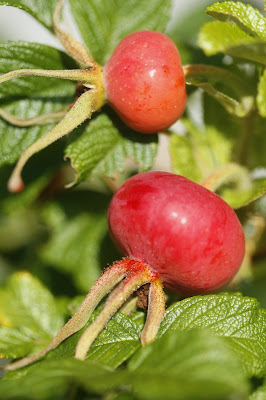


What's this have to do with the way to spend a day? Well, today is my first day of summer. It's the first day that I'm off of work, the sun is blazing, the garden is booming and I have the entire day to do whatever I please.

So while I sipped on my second cup of morning coffee, I made a do-list of sorts:

And at the top, as you can see, is "make rose hip jam" and tell y'all about it. So I set out to pick the lot of them and get started.

A thorn in my plans?
Every rose has it's thorn?
A thorn by any other name still makes you bleed?
Well, lookout, anyway, when you pick these pretty suckers. I got a little carried away once or twice when I saw a particularly pretty berry and now I have perforated fingers.

I picked a bunch:
They're so pretty!
Next step: process. Rose hips are funny little beings. They have these giant sepals that create a stiff crown at one end, and the other end is where the spikes begin. Both of these have to be removed before you can proceed.
Here are the rose hips floating in rinse water after I sliced off the crowns. 
 Next step: seeds. Not just a few seeds, either. Copious amounts of furry, nasty, inedible and irritating seeds. 
Many sources direct you to cut each rose hip open and manually scrape them all out. But that would literally take you all day for 8 cups of fruit.

For example, these seeds all came out of one fruit:
So I have better way.  Stick the suckers in a blender with a bunch of water (you'll have to do this in batches), blend on low for about 10 seconds or so to chop up the fruits (without chopping the seeds too much) and go check your e-mail.
I mean, do something for a minute or so while the mixture separates out because, viola, the seeds float!
At this stage, you can spoon them off the top. A nice tip is when you're struggling to get the last few seeds, fill the blender to the top with water and scrape them off the surface with your fingers.


I filled this bowl with seeds from all the rose hips:
You can bet that those did not go in my compost pile.

After all that blending and seperating and skimming, you're left with this:

Which you then pour into a pot with the water you used to blend and boil it up for a long time.

Ah! Added bonus. I was hot and inspired, or just perspired, and desired some sweet iced tea. Instead of reaching for the mint tea bags, I took some water from my mixture here, strained off the pulp, sweetened it and poured it over ice. 
So, so good.
Guaranteed to satisfy your thirst and vitamin C requirement for a month.

At some point in all the boiling (after about an hour, I'd say), I added a bunch of sugar and some lemon juice. While that was going, I sterilized my jars
After it got to the jamming stage (a little after this picture was taken) I scooped it into the jars, screwed the lids on tight and processed them in a hot water bath for about 15 minutes.
I didn't add any pectin or gelatin so we'll find out how well it gels, but it sure is pretty!

This process takes a while, so I took advantage of the downtime and baked a loaf of bread to enjoy when the jam cools down. The recipe for this no-knead bread is in my archives.

But I caution you against trying it unless you don't mind gaining 10 pounds in a month. :)

I'll report back when we crack open the first jar!